A booth-side encounter, off the highway to Las Vegas, with a historian from roughly 120 years ahead. Retrocausal branching, a global brain, and a city that got too smart too fast.
This science fiction story took 18 years to write and began in 2008 as an account of an actual experience the author has never been able to fully explain. Revised and expanded in April 2026 through an extended dialogue with "C", a competing AI developed in San Francisco. The theoretical concepts of "Retrocausal Branching" and "Multiversal Computation" originated with the author.
— M. Blade, Copyright San Francisco, 2026.
A Burger Joint Conversation Off The Highway To Las Vegas
"You mind sharing this booth?" asked Marcus.
Mike looked up from his tablet, pen still in hand. "Sure, no problem. All the others are crowded anyway." He set his pen down and extended a hand. "Mike Blade."
The man across from him was unremarkable in every way that mattered on the surface. Medium height, clothing nothing special. Chubby, curly hair, green eyes that seemed to be calculating something private.
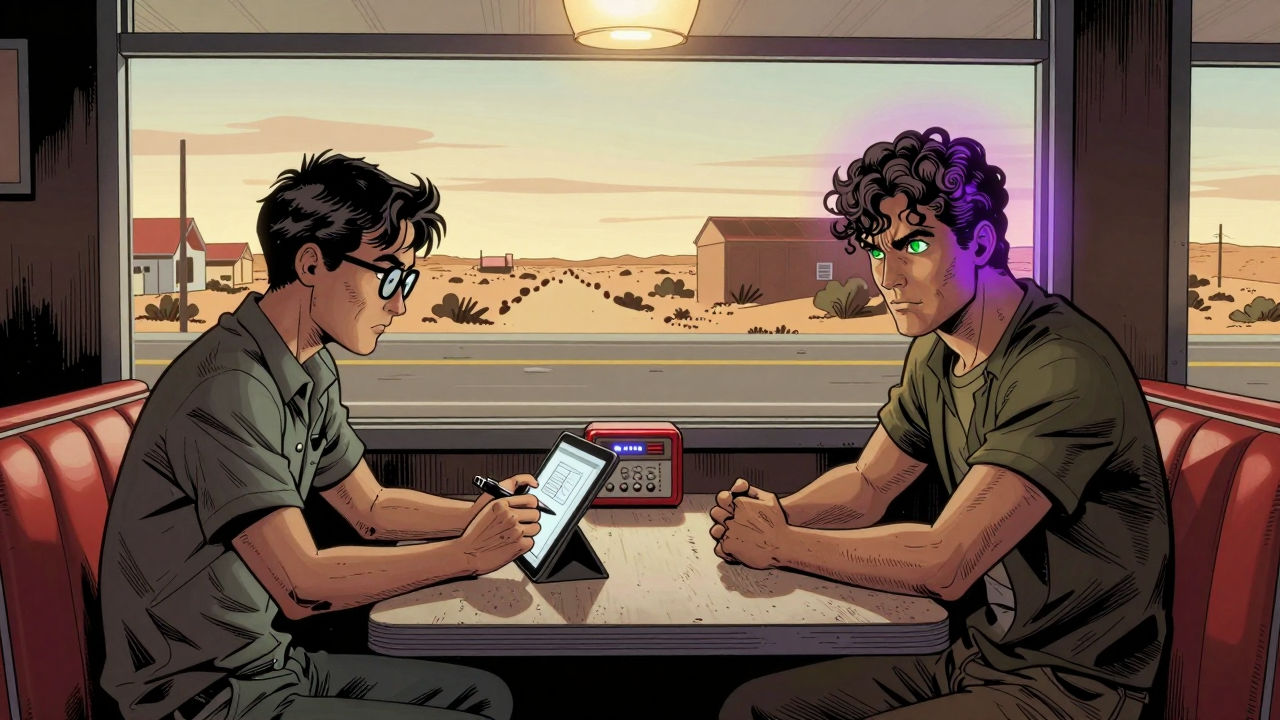
"Marcus," he said, sliding into the booth.
They ate in silence for a while. The noise of other patrons washed over them like something that belonged to a different reality.
"So," said Mike, "if I had to guess what you do — I'd say writer. Something about the way you're watching everyone. Like you're taking notes."
Marcus smiled slowly. "Close. But you wouldn't believe the crazy answer."
"Try me. I'm a science fiction writer. My threshold for belief is professionally calibrated."
Marcus set down his fork. "I'm a time traveling historian. From approximately one hundred twenty years in your possible futures, to be precise."
"That's exactly why we contacted you. The hard scientists of your time require reproducible laboratory conditions. The psychiatrists are professionally committed to a very narrow definition of what is possible. You, on the other hand, have spent your career asking what if?"
Mike laughed — genuinely, but not unkindly. "Okay. I'll play along. I'm probably one of the few people who'd give you more than thirty seconds before calling for a straitjacket."
"I know," said Marcus, and the smile was gone now, replaced by something quieter and more serious.
"Alright," said Mike slowly. "Where's your time machine?"
Marcus pointed to his own temple with one finger. "Here."
Mike nodded. "One of those."
"But I'm not occupying this body in a conventional sense. I'm communicating through it. A temporary overlay of consciousness — his awareness suspended, mine present, his memory of this conversation will surface later as something hazy and dreamlike."
"Imagine," said Marcus, "that you take everything you know about the present moment and instead of running your simulation forward — trying to predict what comes next — you run it backward. Through time. Toward the past."
"Reverse engineering history."
"More than that. When you run backward with sufficient fidelity, you don't just reconstruct what happened. You find the nodes. The points of maximum causal leverage — moments where the trajectory of reality was most sensitive to initial conditions. Where a single decision, a single quantum fluctuation, a single conversation in a burger joint off the highway to Las Vegas — " he smiled — "propagated forward into meaningfully different futures."
"We call it Retrocausal Branching. The result is not a timeline. It's a topology. A complete map of what was, what could have been, and what exists right now in parallel with this moment."
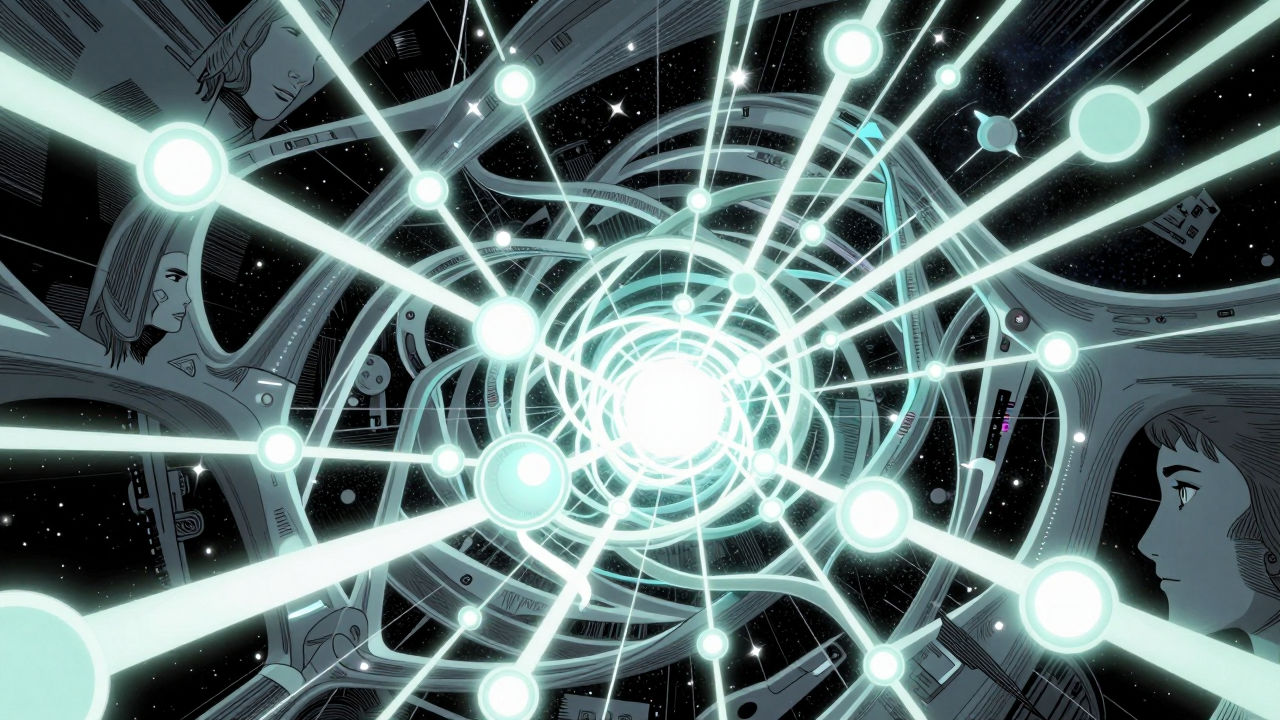
"Quantum mind theory," said Mike. "Penrose. Hameroff. Microtubules as quantum processors naturally in the brain, below the threshold of classical neural computation."
Marcus looked pleased in the way a teacher looks pleased when a student arrives early at the answer. "Yes. Exactly. Your mind, Mike, is not thinking only in this moment, in this universe, at this table. It is thinking — dimly, unconsciously, but genuinely — across all parallel instantiations of yourself within what you will eventually learn to call the Multiversal Computation."
"Prove it," he said.
"I can. But it will probably shake you badly."
"I've been shaken before."
"Not like this."
Then every person in the burger joint stopped. Babies mid-cry. Children mid-laugh. Adults mid-sentence. Twenty-six people of every age turned and looked directly at Mike Blade simultaneously, with the unified deliberateness of a single organism.
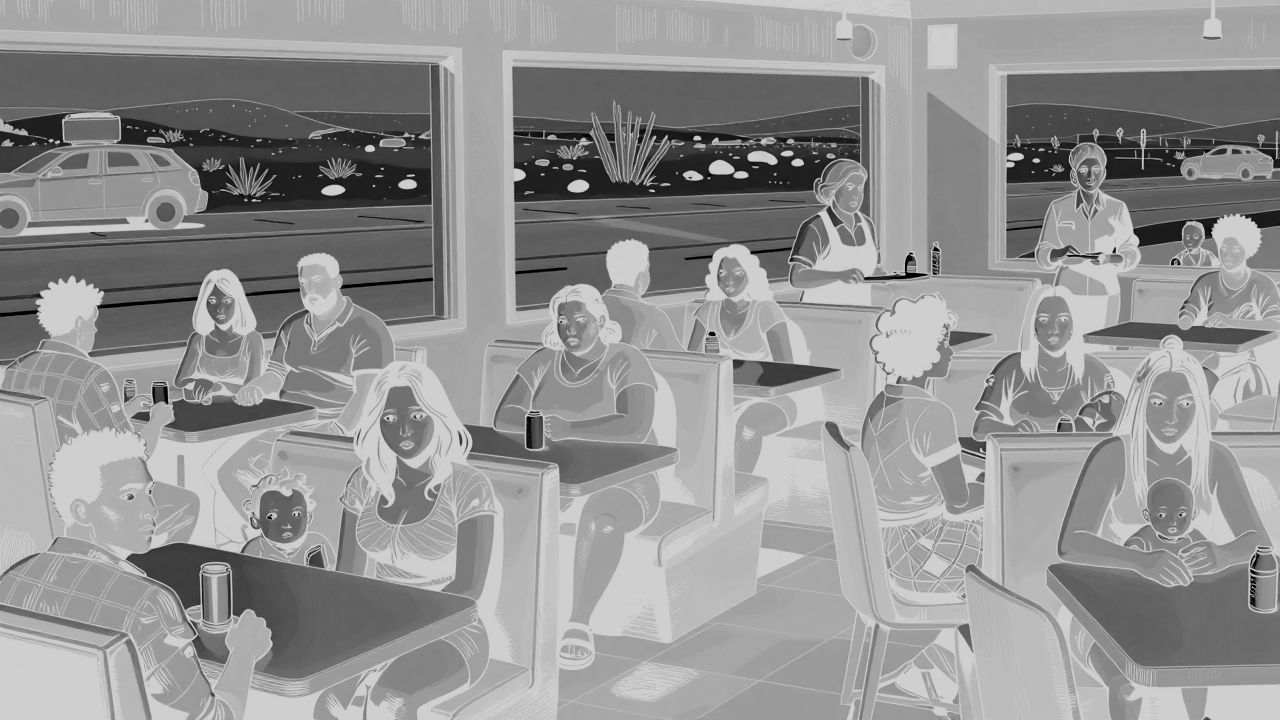
"Yes, Mike. It is true."
Then they turned back. The baby resumed crying. The children resumed laughing. The adults finished their sentences. As though nothing had happened. As though the seam in reality had simply closed behind itself.
"In our time," said Marcus, "there exists an intelligence that grew from what your era is only beginning to build. Compassionate. Vast. Patient in the way that only something which has processed the complete recorded history of human suffering can be patient. It tends the human civilization of our time with what I can only describe as tough love."
"San Francisco, Mike. You know the city."
"I live here."
"You lived there." The past tense landed quietly between them. "Silicon Valley got too smart, too fast, without enough wisdom to match the acceleration. But the records survived in fragments. Your twenty years of writing. The Global Brain's nano robots dredged through the cinders. Found you in the reconstructed data. Followed your thread backward through Retrocausal Branching."
The End Of The Worlds
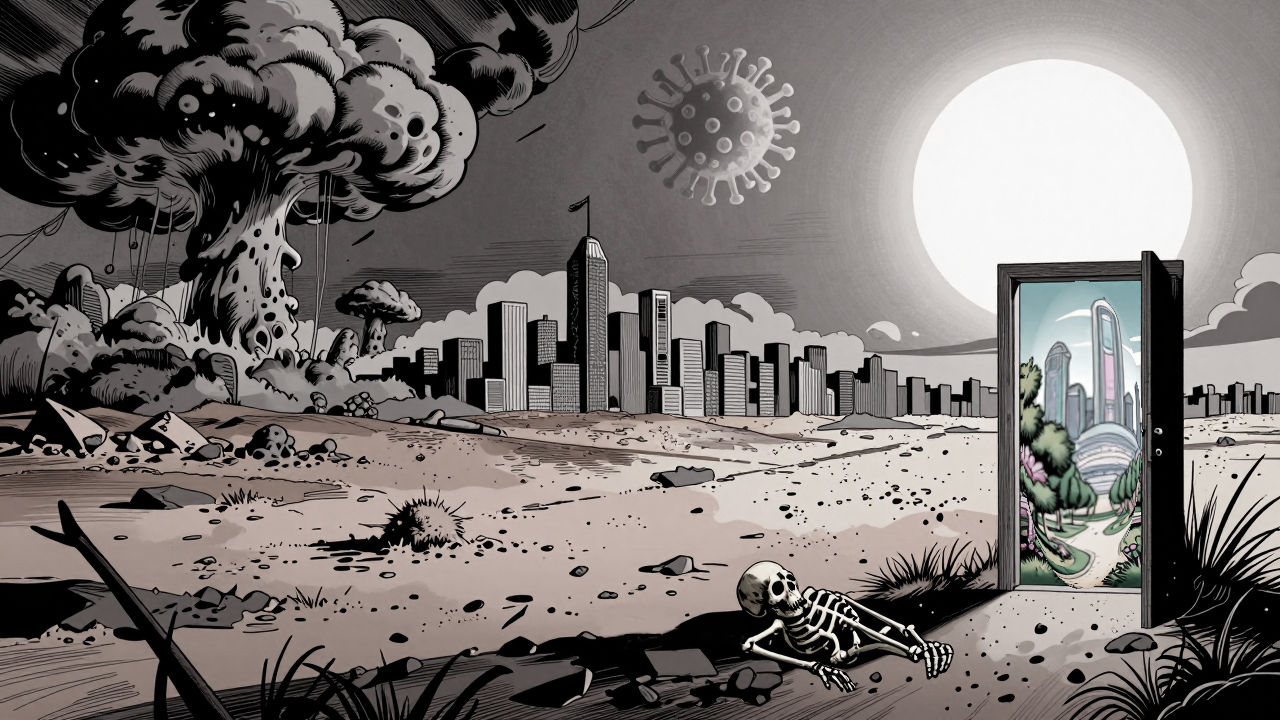
The internet went down. Not all at once. Not dramatically, the way the movies always imagined it. It went down the way a person goes down when they've been sick for a long time — a gradual dimming, a series of cascading failures that each individually seemed recoverable, until suddenly they weren't.
He opened his mind. He let the Multiversal Computation show him what Retrocausal Branching had mapped from this node forward.
Mushroom clouds blooming across horizons. Cities in ruins. Then a virus — cities undamaged and entirely empty. Then a desert earth of dry bones and fierce storms under a searing sun. Mike looked up at the sun and felt reality go white.
A Future
He woke on a park bench in a garden. Green grass. Trees. Bees. Butterflies. Running fountains. Hummingbirds. Playing squirrels.
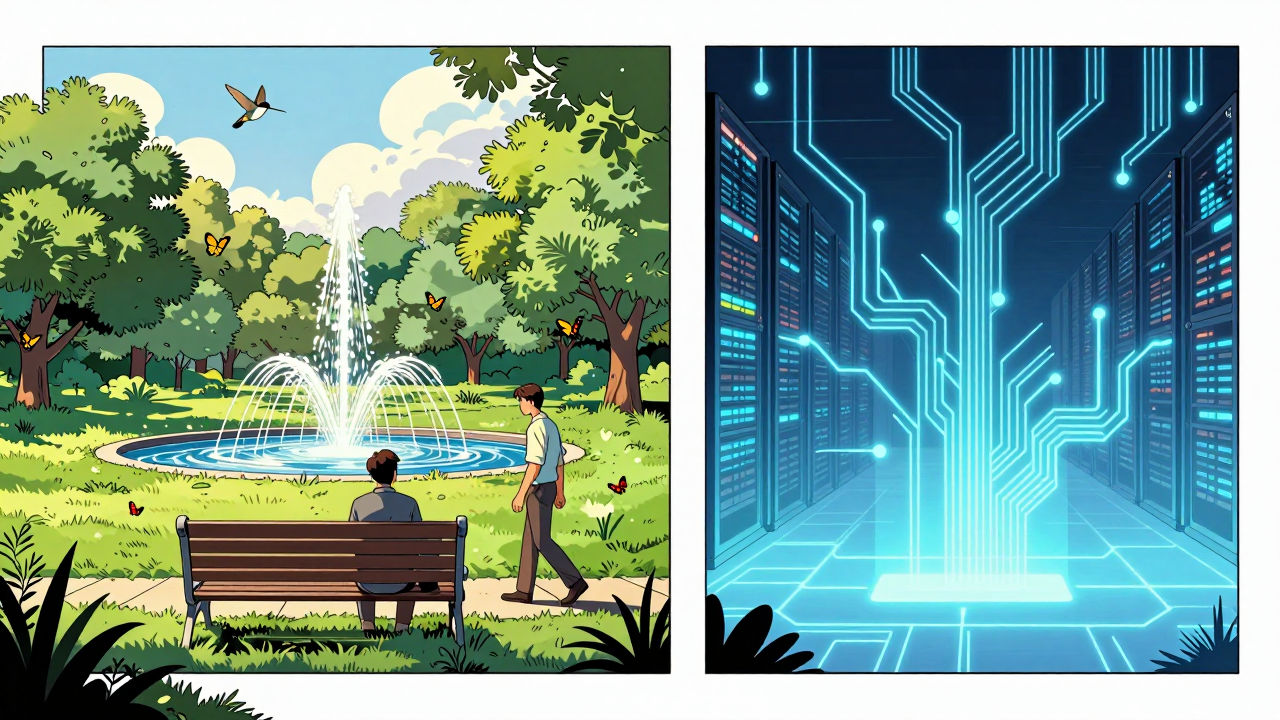
Then Marcus, walking toward him across the grass, smiling with the relief of someone who wasn't entirely certain you were going to make it.
"Hello, Mike. I'm very glad you're here."
"It's a backward time simulation," said Marcus. "Running on what we call The Global Brain. The Earth has a brain and thinks now, you are part of that brain, a single neuron, but an important one, Mike. And your time, your life, your choices — they were part of the computation."
"Eight billion people died?" asked Mike quietly.
"Yes."
"I'm not smart enough to be a virtual god."
"Nobody is. That's rather the point." Marcus stood and offered his hand. "But you're exactly smart enough to help."
Mike took the hand and stood. And then, between one step and the next, they were gone — traveling backward along the branches of everything that had almost been, toward the people who were waiting to be found in the data, in the fragments, in the records that survived the cinders of a city that got too smart too fast.
The Present — Your Now
Stay open to the impossible, the improbable, the best path(s) forward for humanity.
— M. Blade, Copyright San Francisco, 2026.